



Upper & Lower Eyelid Lifts [Blepharoplasty]
Each year thousands of men and women choose eyelid surgery to help restore a more energized, youthful appearance. Blepharoplasty or eyelid surgery can correct sagging eyelids, remove fatty pouches or “bags” under the eyes, and remove excess skin. Sometimes referred to as a “mini-facelift”, blepharoplasty has become one of the most popular cosmetic procedures because of its high level of patient satisfaction. This procedure can be done alone or in conjunction with a facelift or brow lift.
CONSULTATION
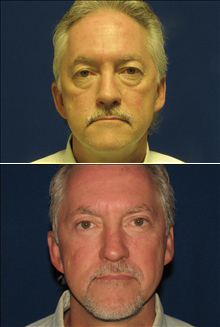
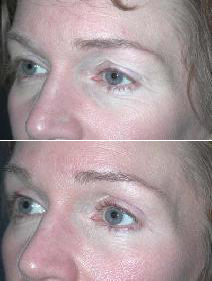
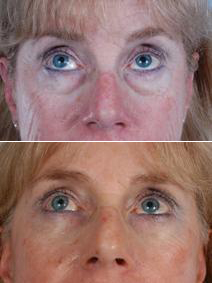
During your initial cosmetic surgery evaluation, Dr. Cook will evaluate the health of your eyes; discuss your expectations, and the probable outcome of treatment. You will be shown before and after photographs of patients having similar conditions and you will receive an explanation of your treatment. Blepharoplasty is generally considered a cosmetic procedure and most insurance companies will not pay for the procedure. However, if your eyelids are encroaching upon your field of vision, the procedure may be covered as “medically necessary” surgery. We would be happy to contact your insurance carrier to determine if they cover the procedure.
WHAT TO EXPECT ON PROCEDURE DAY
You will arrive 30 minutes prior to your scheduled procedure. Once you have been checked-in and settled comfortably, you will be prepared for surgery. Your before photographs will be taken and you will be given a mild sedative to relax. Blepharoplasty is generally performed using a local anesthetic. If you are having surgery performed on your upper eyelids, Dr. Cook will remove the excess skin, muscle, and fatty tissue that have accumulated in the inside corner of your eye. The incisions will be made along the natural folds in your skin so that as the incisions heal, they become difficult, if not impossible to see.If your surgery is on your lower eyelids, Dr. Cook will make the incision inside or behind the eyelid (providing there is not too much excess skin). This technique is called a transconjunctival blepharoplasty, which allows the removal of fatty deposits while avoiding the need for an external incision. If you have excessive skin or muscle folds below the eye, an incision may also be made just below the base of the eyelashes. As this incision heals, the fine scar should become barely visible.
After the procedure you will need someone to drive you home. You may experience some bruising and swelling for a week to a month after surgery. Frozen peas placed in a Ziploc bag and head elevation will help reduce these effects. Dr. Cook will also prescribe an eye ointment to be used on your incision to keep the area moist and clean.
View Eyelid Surgery Before and After Photos

Skin Cancer Reconstruction
Skin Cancer commonly involves the skin of the eyelid and adjacent facial areas. Eyelid skin cancer, which most commonly occurs on the lower eyelid, usually presents as a painless elevated nodule. Other signs of eyelid cancer include missing eyelashes, ulceration, bleeding and crusting. Dr. Cook performs in office biopsies to confirm the diagnosis of skin cancer if any of the above eyelid signs are present.
The most common type of eyelid skin cancer is basal cell carcinoma, with squamous cell carcinoma being the second most prevalent. Both types of skin cancer are typically slow growing and tend to invade locally. Dr. Cook has written the definitive paper on the types and frequencies of skin cancers that occur around the eyelids. More aggressive types of eyelid skin cancer, which can metastasize (spread to other parts of the body), include melanoma and sebaceous cell carcinoma. Therefore, early detection with prompt surgical intervention is very important in the management of eyelid skin cancers.
The treatment of eyelid skin cancer involves one of two methods. The most common method of removal of eyelid and facial skin cancer is through a technique called Mohs’ Micrographic excision (or Mohs’ surgery). Frederick Mohs was a dermatologist and pathologist who developed this technique at the University of Wisconsin-Madison, where Dr. Cook trained. Using this method, the skin cancer is removed in small amounts and examined at the time of removal to make sure no skin cancer is left behind. This is the method that has the lowest recurrence rate. Mohs’ surgery and the subsequent repair are done in the office. The second method is through excision of the tumor under frozen section (the pathologist confirms that the margins are free of cancer while the patient is in the operating room) with reconstruction of the eyelid defect. The use of frozen section biopsy confirms that the tumor is completely removed. Dr. Cook will choose the reconstructive surgical technique based upon the size and location of the eyelid skin cancer.
Ophthalmic Surgery
Information coming soon!